
Organoheterocyclic compounds


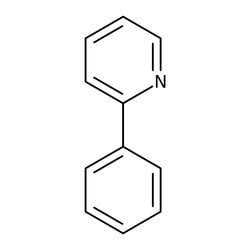
Tris(2-phenylpyridinato)iridium(III) (purified by sublimation) 95.0+%, TCI America™
CAS: 94928-86-6 Molecular Formula: C33H24IrN3 Molecular Weight (g/mol): 654.793 MDL Number: MFCD04039766 InChI Key: NSABRUJKERBGOU-UHFFFAOYSA-N Synonym: Ir(ppy)3 PubChem CID: 59117881 IUPAC Name: iridium(3+);2-phenylpyridine SMILES: C1=CC=C([C-]=C1)C2=CC=CC=N2.C1=CC=C([C-]=C1)C2=CC=CC=N2.C1=CC=C([C-]=C1)C2=CC=CC=N2.[Ir+3]
![Tris[1-phenylisoquinoline-C2,N]iridium(III) (purified by sublimation) 99.0+%, TCI America™](https://assets.fishersci.com/TFS-Assets/CCG/Chemical-Structures/chemical-structure-cas-435293-93-9.jpg-250.jpg)
Tris[1-phenylisoquinoline-C2,N]iridium(III) (purified by sublimation) 99.0+%, TCI America™
CAS: 435293-93-9 Molecular Formula: C45H30IrN3 Molecular Weight (g/mol): 804.973 MDL Number: MFCD09842770 InChI Key: NDBCGHNTWCYIIU-UHFFFAOYSA-N Synonym: Ir(piq)3 PubChem CID: 53384374 IUPAC Name: iridium(3+);1-phenylisoquinoline SMILES: C1=CC=C([C-]=C1)C2=NC=CC3=CC=CC=C32.C1=CC=C([C-]=C1)C2=NC=CC3=CC=CC=C32.C1=CC=C([C-]=C1)C2=NC=CC3=CC=CC=C32.[Ir+3]
![(4,4'-Di-tert-butyl-2,2'-bipyridine)bis[(2-pyridinyl)phenyl]iridium(III) Hexafluorophosphate 85.0+%, TCI America™](https://assets.fishersci.com/TFS-Assets/CCG/Chemical-Structures/chemical-structure-cas-676525-77-2.jpg-250.jpg)
(4,4'-Di-tert-butyl-2,2'-bipyridine)bis[(2-pyridinyl)phenyl]iridium(III) Hexafluorophosphate 85.0+%, TCI America™
CAS: 676525-77-2 Molecular Formula: C40H40F6IrN4P Molecular Weight (g/mol): 913.969 InChI Key: VCIVELSSYHAWGC-UHFFFAOYSA-N PubChem CID: 44239994 IUPAC Name: 4-tert-butyl-2-(4-tert-butylpyridin-2-yl)pyridine;iridium(3+);2-phenylpyridine;hexafluorophosphate SMILES: CC(C)(C)C1=CC(=NC=C1)C2=NC=CC(=C2)C(C)(C)C.C1=CC=C([C-]=C1)C2=CC=CC=N2.C1=CC=C([C-]=C1)C2=CC=CC=N2.F[P-](F)(F)(F)(F)F.[Ir+3]

Ambeed Iridium 1 4 4 bis 1 1dimet
Iridium(1+), [4,4'-bis(1,1-dimethylethyl)-2,2'-bipyridine-κN1,κN1']bis[3-fluoro-5-(trifluoromethyl)-2-[5-(trifluoromethyl)-2-pyridinyl-κN]phenyl-κC]-, (OC-6-33)-, hexafluorophosphate(1-) (1:1), 2222402-20-0, 98%

Ambeed Iridium 1 4 4 bis 1 1dimet
Iridium(1+), [4,4'-bis(1,1-dimethylethyl)-2,2'-bipyridine-κN1,κN1']bis[3-fluoro-5-(trifluoromethyl)-2-[5-(trifluoromethyl)-2-pyridinyl-κN]phenyl-κC]-, (OC-6-33)-, hexafluorophosphate(1-) (1:1), 2222402-20-0, 98%
Ambeed Iridium 1 4 4 bis 1 1dimet
Iridium(1+), [4,4'-bis(1,1-dimethylethyl)-2,2'-bipyridine-κN1,κN1']bis[3-fluoro-5-(trifluoromethyl)-2-[5-(trifluoromethyl)-2-pyridinyl-κN]phenyl-κC]-, (OC-6-33)-, hexafluorophosphate(1-) (1:1), 2222402-20-0, 98%
Ambeed Iridium 1 4 4 bis 1 1dimet
Iridium(1+), [4,4'-bis(1,1-dimethylethyl)-2,2'-bipyridine-κN1,κN1']bis[3-fluoro-5-(trifluoromethyl)-2-[5-(trifluoromethyl)-2-pyridinyl-κN]phenyl-κC]-, (OC-6-33)-, hexafluorophosphate(1-) (1:1), 2222402-20-0, 98%
Ambeed Iridium 1 4 4 bis 1 1dimet
Iridium(1+), [4,4'-bis(1,1-dimethylethyl)-2,2'-bipyridine-κN1,κN1']bis[3-fluoro-5-(trifluoromethyl)-2-[5-(trifluoromethyl)-2-pyridinyl-κN]phenyl-κC]-, (OC-6-33)-, hexafluorophosphate(1-) (1:1), 2222402-20-0, 98%
Medchemexpress LLC Chloro-1,5-cyclooctadiene iridium(I) dimer | 12112-67-3 | 671.70 | 250 MG

This biochemical reagent is suitable for life science related research. It serves as a precursor to various iridium complexes and is applied in homogeneous catalysis for reactions including carbonylation, hydrosilylation, hydroformylation, asymmetric allylic substitutions, metatheses, and chiral catalysis. Additionally, it plays a role in preparing Crabtree's catalyst for hydrogenation and hydrogen-transfer reactions.
- Precursor to other iridium complexes
- Applied in homogeneous catalysis for reactions such as carbonylation, hydrosilylation, hydroformylation, asymmetric allylic substitutions, metatheses, and chiral catalysis
- Involved in the preparation of Crabtree's catalyst
- Used for hydrogenation and hydrogen-transfer reactions
Medchemexpress LLC Tris(2-phenylpyridinato-C2,N)iridium(III) | 94928-86-6 | 654.78 | 100 MG
Tris(2-phenylpyridinato-C2,N)iridium(III) (Ir(ppy)3) is an iridium(III) containing organometallic complex used as a phosphorescent light-emitting material. It demonstrates high luminous efficiency and good thermal stability, making it suitable for organic optoelectronics, particularly for improving the luminescence efficiency and stability of organic light-emitting diodes (OLEDs).
- Iridium(III)-containing organometallic complex
- Used as a phosphorescent light-emitting material
- Demonstrates high luminous efficiency
- Exhibits good thermal stability
- Suitable for organic optoelectronics
- Enhances luminescence efficiency of OLEDs
- Improves stability of OLEDs
Medchemexpress LLC Tris(2-phenylpyridinato-C2,N)iridium(III) | 94928-86-6 | 654.78 | 25 MG
Tris(2-phenylpyridinato-C2,N)iridium(III) (Ir(ppy)3) is an iridium(III) containing organometallic complex that functions as a phosphorescent light-emitting material. It exhibits high luminous efficiency and good thermal stability, making it suitable for use in organic optoelectronics, particularly for enhancing the luminescence efficiency and stability of organic light-emitting diodes (OLEDs).
- Organometallic complex
- Phosphorescent light-emitting material
- High luminous efficiency
- Good thermal stability
- Suitable for organic optoelectronics
- Improves luminescence efficiency of OLEDs
- Improves stability of OLEDs
Medchemexpress LLC Tris(2-phenylpyridinato-C2,N)iridium(III) | 94928-86-6 | MFCD12022527 | 654.78 | 50 MG
Tris(2-phenylpyridinato-C2,N)iridium(III) (Ir(ppy)3) is an organometallic complex containing iridium(III) that serves as a phosphorescent light-emitting material. It offers high luminous efficiency and good thermal stability, making it suitable for use in organic optoelectronics, particularly for enhancing the luminescence efficiency and stability of organic light-emitting diodes (OLEDs).
- Phosphorescent light-emitting material
- High luminous efficiency
- Good thermal stability
- Suitable for organic optoelectronics
- Enhances luminescence efficiency and stability of OLEDs

Medchemexpress LLC Pentamethylcyclopentadienyl iridium(III) chloride dimer | 12354-84-6 | MFCD00075435 | 98.0% | 796.70 | C20H30Cl4Ir2 | 50 MG
[Ir(Cp-)Cl2]2 is an organometallic iridium(III) chloride dimer used as a precursor to catalysts for asymmetric transfer hydrogenation of ketones and in the synthesis of amines. It is supplied as an orange to reddish-brown solid for research use and requires light protection and inert storage.
- Used as a precursor for asymmetric transfer hydrogenation catalysts.
- Applicable in greener amine synthesis reactions.
- Orange to reddish-brown solid, suitable for small-scale research.
- Store at 4°C, protect from light, and keep under nitrogen for stability.
- For research use only; not intended for human or patient use.

Medchemexpress LLC Dichloro(pentamethylcyclopentadienyl)iridium(III) dimer | 12354-84-6 | MFCD00075435 | ≥99.0% | 796.70 g·mol⁻¹ | C20H30Cl4Ir2 | 100 MG
[Ir(Cp-)Cl2]2 (dichloro(pentamethylcyclopentadienyl)iridium(III) dimer) is an organometallic iridium complex supplied for research use. It serves as a precursor to catalysts for asymmetric transfer hydrogenation of ketones and is employed in catalytic amine synthesis. The compound is a solid, typically orange to reddish brown, with formula C20H30Cl4Ir2 and an approximate molecular weight of 796.70 g·mol⁻¹.
- High purity ≥99.0% suitable for research and synthetic applications.
- Precursor for asymmetric transfer hydrogenation catalysts.
- Useful catalyst for greener amine synthesis and related transformations.
- Orange to reddish brown solid offering easy handling and storage.
- Chemical identity confirmed by CAS number and molecular formula for traceability.
Medchemexpress LLC Tris(2-phenylpyridinato-C2,N)iridium(III) (Ir(ppy)3) | 94928-86-6 | 654.78 | 500 MG
Tris(2-phenylpyridinato-C2,N)iridium(III) (Ir(ppy)3) is an iridium(III)-containing organometallic complex used as a phosphorescent light-emitting material. This compound exhibits high luminous efficiency and good thermal stability, making it suitable for organic optoelectronics, particularly for improving the luminescence efficiency and stability of organic light-emitting diodes (OLEDs).
- High luminous efficiency
- Good thermal stability
- Can be used in organic optoelectronics
- Especially effective in improving the luminescence efficiency and stability of organic light-emitting diodes (OLEDs)
- 1
- 2