
Quinolines and derivatives


Abcam Quinine hemisulfate monohydrate, Potassium channel blocker, 25G
MW 391.47 g/mol. Potassium channel blocker. Antimalarial, anticholinergic, antihypertensive and hypoglycemic agent. Inhibits mitochondrial ATP-regulated potassium channel. Also used to study the metabolism of biocrystalized heme, hemozoin, in malarial parasites and to study the toxicity of heme (FP)-complexes.
The product is subject to the following: Abcam Restricted Use Statement


Medchemexpress LLC Sulfo-cyanine3 azide (potassium) | 95.3% | 736.94 | 1 MG

Sulfo-cyanine3 azide potassium is an azide cyanine dye and fluorescent probe (Ex/Em=548/563 nm). It can be used for synthesis of fused tricyclic heterocycles, producing immunostimulatory agents. It contains an azide group and can undergo copper-catalyzed azide-alkyne cycloaddition (CuAAc) with molecules containing alkyne groups, or ring strain-promoted alkyne-azide cycloaddition (SPAAC) with molecules containing DBCO or BCN groups.
- Azide cyanine dye and fluorescent probe (Ex/Em=548/563 nm).
- Used for synthesis of fused tricyclic heterocycles, producing immunostimulatory agents.
- Contains an azide group.
- Undergoes copper-catalyzed azide-alkyne cycloaddition (CuAAc) with molecules containing alkyne groups.
- Undergoes ring strain-promoted alkyne-azide cycloaddition (SPAAC) with molecules containing DBCO or BCN groups.
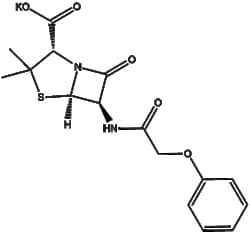
Apexbio Technology LLC Penicillin V potassium salt 132-98-9 200mg
Penicillin V potassium salt (132-98-9) is a small-molecule inhibitor targeting bacterial cell wall peptidoglycan synthesis It is designed to inhibit this biosynthetic pathway thereby suppressing the growth of Gram-positive bacteria Penicillin V potassium salt exerts its biological activity primarily through inhibition of bacterial cell wall synthesis In microbial susceptibility assays Penicillin V potassium salt demonstrates inhibitory effects with IC50 values ranging from approximately 0 01 to 0 5 g/mL for sensitive bacterial strains Based on these pharmacological properties Penicillin V potassium salt holds research potential in studies investigating Gram-positive bacterial resistance mechanisms cell-wall targeting antibiotic actions and experimental models of upper respiratory tract infections including otitis media sinusitis pharyngitis and tonsillitis

Medchemexpress LLC Potassium clavulanate cellulose | 61177-45-5 | 98.0% | 238.26 | 200 MG
Potassium clavulanate cellulose is a mixture of potassium clavulanate and cellulose. It acts as a bacterial β-lactamase inhibitor. Clavulanate potassium, a form of Clavulanic acid, combats bacteria resistant to penicillins and other antibiotics. When combined with amoxicillin, it can be used for research on various bacterial infections such as sinusitis, pneumonia, ear infections, bronchitis, urinary tract infections, and skin infections.
- Acts as a bacterial β-lactamase inhibitor
- Combats bacteria resistant to penicillins and other antibiotics
- Suitable for research on various bacterial infections
- Can be combined with amoxicillin for infection research

Medchemexpress LLC Sulfo-cyanine3 azide (potassium) | 1658416-54-6 | 95.3% | 10 MG
Sulfo-cyanine3 azide (potassium) is a water-soluble, sulfonated cyanine fluorescent azide for bioorthogonal labeling via azide-alkyne click chemistry. It exhibits Cy3-like optical properties with excitation/emission near 548/563 nm, and is supplied as a potassium salt with a certificate of analysis for documented purity.
- Cy3-like excitation/emission (548/563 nm).
- Water-soluble sulfonated dye for aqueous labeling.
- Reactive azide group for azide-alkyne click chemistry.
- Supplied as a potassium salt with certificate of analysis and documented purity.
- Suitable for labeling proteins, peptides, and oligonucleotides.

Selleck Chemical LLC Quinidine hydrochloride monohydrate S4681-25mg
Quinidine hydrochloride monohydrate is an anti-arrythmic agent and a potent potassium channel inhibitor with IC50 of 19 9 M

Selleck Chemical LLC Quinidine hydrochloride monohydrate S4681-1g
Quinidine hydrochloride monohydrate is an anti-arrythmic agent and a potent potassium channel inhibitor with IC50 of 19 9 M
Medchemexpress LLC Tertiapin-Q | 910044-56-3 | 99.8% | 2452.00 | 1 MG
Tertiapin-Q is a highly selective blocker of G protein-coupled inwardly rectifying potassium (GIRK1/4) heterodimer and renal outer medullary potassium channel (ROMK1/Kir1.1). It also potently and selectively blocks Kir3.1-Kir3.4 channels and calcium activated large conductance potassium channels. Tertiapin-Q significantly prolongs the atrial effective refractory period in control and rapid atrial pacing rabbits, with a greater effect in the latter. Additionally, it acts as a muscarinic acetylcholine receptor-operated K+ current (IK,Ach) blocker.
- Highly selective blocker of GIRK1/4 heterodimer and ROMK1 (Kir1.1)
- Potently blocks Kir3.1-Kir3.4 channels and calcium activated large conductance potassium channels
- Prolongs atrial effective refractory period
- Acts as a muscarinic acetylcholine receptor-operated K+ current blocker
Medchemexpress LLC Tertiapin-Q | 910044-56-3 | 99.8% | 2452.00 | 5 MG
Tertiapin-Q is a highly selective blocker of GIRK1/4 heterodimer and ROMK1 (Kir1.1) potassium channels, intended for research use only. It also potently and selectively blocks Kir3.1-Kir3.4 channels and calcium-activated large conductance potassium channels, blocking somatostatin (SS-14)-activated current. As a muscarinic acetylcholine receptor-operated K+ current (IK,Ach) blocker, Tertiapin-Q significantly prolongs the atrial effective refractory period (AERP).
- Highly selective blocker of GIRK1/4 heterodimer and ROMK1 (Kir1.1) potassium channels
- Potently and selectively blocks Kir3.1-Kir3.4 and calcium-activated large conductance potassium channels
- Blocks somatostatin (SS-14)-activated current
- Functions as a muscarinic acetylcholine receptor-operated K+ current (IK,Ach) blocker
- Prolongs atrial effective refractory period (AERP)
Medchemexpress LLC Quinine hydrochloride | 130-89-2 | 99.8% | 360.88 | 10 MG
Quinine hydrochloride is an alkaloid derived from the bark of the cinchona tree, acting as an anti-malaria agent and potassium channel inhibitor. It inhibits WT mouse Slo3 (KCa5.1) channel currents evoked by voltage pulses to +100 mV.
- Acts as an anti-malaria agent.
- Functions as a potassium channel inhibitor.
- Inhibits WT mouse Slo3 (KCa5.1) channel currents.