
Sugar acids and derivatives


AdipoGen 3OH-C10-L-HSL
Chemical. CAS 192883-12-8. Formula C14H25NO4. MW 271.35. Synthetic. N-3-hydroxydecanoyl-L-homoserine lactone is a small diffusible signaling molecule secreted by various bacteria and involved in quorum sensing, thereby controlling gene expression and affecting cellular metabolism. This lactone is produced via lactonolysis from 3-oxodecanoyl-homoserine lactone, altering quorum sensing or contributing to quorum quenching. The applications of this molecule include regulation of virulence and exoproteases.


Medchemexpress LLC Integrin alpha L beta 2 protein, mouse (HEK293, His) | 95.0% | 50UG

Integrin alpha L beta 2 protein (mouse) is a recombinant heterodimeric extracellular domain co-expressed in HEK293 cells and purified with a C-terminal His tag. The preparation is supplied as a purified protein for use in biochemical and cell-based assays requiring the integrin extracellular domain, including receptor-binding and cell-adhesion studies. Molecular weights correspond to αL (160-180 kDa) and β2 (90-105 kDa); purity is typically ≥95%.
- Recombinant heterodimeric integrin representing alpha L and beta 2 subunits.
- Mouse origin, HEK293 expression for mammalian-like post-translational modifications.
- C-terminal His tag for detection and purification.
- Molecular weight: αL 160-180 kDa, β2 90-105 kDa.
- High purity, typically ≥95%.
- Suitable for receptor-binding, cell-adhesion, and signaling assays.
- Provided in a small-scale purified format for research use.
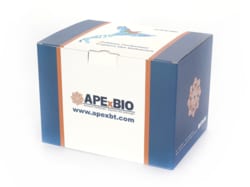
Apexbio Technology LLC HyperTrap Heparin FF Column 1ml
HyperTrap Heparin FF Column is an affinity chromatography medium designed for the purification of heparin-binding biomolecules The column exploits the strong ionic and specific interactions between immobilized heparin and target proteins such as growth factors coagulation factors and certain enzymes enabling selective retention and efficient separation from complex biological mixtures This tool is widely utilized in the isolation and characterization of heparin-binding proteins investigation of protein glycosaminoglycan interactions and purification of bioactive factors for downstream functional assays and structural analyses

Medchemexpress LLC Integrin alpha V beta 3 protein | >95.0% | 100UG
Recombinant mouse integrin αVβ3 heterodimer, biotinylated and expressed in HEK293 cells with C-terminal His and Avi tags; supplied for biochemical and cell-based assays including binding studies and immobilization.
- Biotinylated for detection and streptavidin-based immobilization.
- Expressed in mammalian cells to preserve native folding and post-translational modifications.
- His and Avi tags facilitate purification and biotinylation workflows.
- High purity (>95%) as determined by reducing SDS-PAGE.
- Suitable for ELISA, surface plasmon resonance, and receptor binding assays.
- Store at -20°C and freeze aliquots for extended storage.

Medchemexpress LLC Beta-Cortol | 667-65-2 | 99.9% | 368.51 | 10 MG
Beta-Cortol is an O-glycosylated compound and a cortisol metabolite that can be isolated from the leaves of the mulberry cultivar Yu 711. Its concentration significantly decreases when the plant is subjected to drought stress. Beta-Cortol acts as a biomarker, with serum levels in early non-small cell lung cancer models showing a downregulation to 1/8 of the preoperative level after tumor resection. Due to these significant changes under specific pathological conditions, Beta-Cortol is extensively used in studies related to early non-small cell lung cancer.
- O-glycosylated compound and cortisol metabolite.
- Isolated from the leaves of mulberry cultivar Yu 711.
- Concentration decreases significantly under drought stress in plants.
- Serves as a biomarker for early non-small cell lung cancer.
- Serum levels are significantly downregulated in non-small cell lung cancer models after tumor resection.
AdipoGen 3-oxo-C11-L-HSL
Chemical. CAS 216596-70-2. Formula C15H25NO4. MW 283.4. Synthetic. N-3-Oxoundecanoyl-L-homoserine lactone is a small diffusible signaling molecule and is a member of N-acyl-homoserine lactone family. N-acylhomoserine lactones AHL are involved in quorum sensing, controlling gene expression, and cellular metabolism. The diverse applications of this kind of molecule include regulation of virulence in general, infection prevention, and formation of biofilms. Numerous species of bacteria employ 3OC11-HSL in cell-to-cell communication. Shown to have immune suppressive activity, inhibiting murine and human leucocyte proliferation.

Medchemexpress LLC Dodecanedioic acid-d4 | 97543-02-7 | 234.33 | 10 MG
Dodecanedioic acid-d4 is the deuterium labeled version of Dodecanedioic acid. Dodecanedioic acid is an orally active straight-chain dicarboxylic acid that acts as an alternative energy substrate. It can be rapidly oxidized during exercise, reducing muscle fatigue without stimulating insulin secretion, and also exhibits blood glucose-lowering activity in non-insulin-dependent diabetes mellitus.
- Deuterium labeled compound for quantitative tracing during drug development.
- Reduces muscle fatigue during exercise.
- Exhibits blood glucose-lowering activity.
Medchemexpress LLC Sapintoxin D | 80998-07-8 | 99.9% | 10 MG
Sapintoxin D is a fluorescent phorbol ester used to study the activation of protein kinase C (PKC). It functions as a calcium-dependent PKC activator, making it suitable for various research applications in cell biology and biochemistry.
- Fluorescent phorbol ester
- Activates protein kinase C (PKC)
- Calcium-dependent mechanism
- Appears as a white to off-white solid
- High purity of 99.91%
- Soluble in DMSO for in vitro studies
Apexbio Technology LLC Beta-Lapachone 4707-32-8 10mg
Beta-Lapachone (CAS 4707-32-8) is a small molecule inhibitor of DNA topoisomerase I In DNA unwinding assays beta-Lapachone suppresses topoisomerase I-mediated DNA relaxation at concentrations as low as 1 M without inhibiting topoisomerase II or inducing topoisomerase I-dependent DNA cleavage It exhibits broad cytotoxicity against human cancer cell lines such as AD2780s HT-29 DLD G480 and MCF-7 with IC50 values ranging from 2 to 5 M The compound induces cell death through cytochrome c release triggering both apoptosis and necrosis and affects cell cycle progression causing S-phase and G2/M arrest in different carcinoma cell models Beta-Lapachone is widely utilized in studies investigating topoisomerase I inhibition cancer cell cytotoxicity and cell cycle regulation

Medchemexpress LLC 4-methylumbelliferyl alpha-L-arabinofuranoside | 77471-44-4 | MFCD00057308 | 99.9% | C15H16O7 | 10MG
4-Methylumbelliferyl alpha-L-arabinofuranoside is a fluorogenic glycosidase substrate used to measure α-L-arabinofuranosidase activity. Enzymatic cleavage releases the fluorescent reporter 4-methylumbelliferone, enabling sensitive fluorometric assays for enzyme kinetics, inhibitor screening, and biochemical studies.
- Fluorogenic substrate for α-L-arabinofuranosidase assays.
- Releases 4-methylumbelliferone for high-sensitivity fluorometric detection.
- Suitable for enzyme kinetics, inhibitor screening, and activity profiling.
- High purity improves assay reproducibility and signal-to-noise ratio.
- Available in small, research-scale quantities for laboratory use.

Medchemexpress LLC 4-methylumbelliferyl β-D-cellobioside | 72626-61-0 | MFCD00063279 | >98.0% | C22H28O13 | 10MG
4-Methylumbelliferyl β-D-cellobioside is a fluorogenic glycoside substrate used to measure cellulase and related β-glucosidase activity. Enzymatic hydrolysis liberates 4-methylumbelliferone, a fluorescent reporter commonly quantified in biochemical and enzymatic assays for activity and kinetics studies.
- Fluorogenic substrate for cellulase and β-glucosidase assays.
- Releases fluorescent 4-methylumbelliferone upon enzymatic cleavage.
- High purity (>98.0%) suitable for quantitative assays.
- Known molecular weight (500.45 g·mol⁻¹) and chemical formula (C22H28O13).
- Available in small research-scale quantities for laboratory use.

Medchemexpress LLC 4-methylumbelliferyl α-D-glucopyranoside | 17833-43-1 | MFCD00067661 | 100.0% | 338.31 g·mol⁻¹ | C16H18O8 | 5 MG
4-Methylumbelliferyl α-D-glucopyranoside is a fluorogenic substrate for α-glucosidase that releases 4-methylumbelliferone upon enzymatic hydrolysis. The liberated fluorophore enables sensitive, quantitative measurement of GAA activity in biochemical assays and newborn screening workflows for lysosomal storage disorders. The reagent is provided in small research quantities and requires controlled storage to preserve stability.
- Fluorogenic substrate for α-glucosidase assays.
- Enzymatic cleavage yields fluorescent 4-methylumbelliferone for quantitation.
- Excitation ~360 nm, emission ~445-455 nm (read at ~450 nm).
- Applicable to newborn screening and research on lysosomal storage disorders.
- Supplied in small research-scale quantities; follow storage recommendations.
- Storage: store at 4°C under inert gas; in solution, store at -80°C or -20°C as specified.

Medchemexpress LLC 4-methylumbelliferyl stearate | 79408-85-8 | MFCD00057311 | 99.0% | 442.63 g/mol | C28H42O4 | 250 MG
4-Methylumbelliferyl stearate is a fluorogenic biochemical reagent used as a substrate for esterase and lipase assays. Enzymatic hydrolysis releases the fluorescent 4-methylumbelliferone (4-MU), enabling sensitive, quantitative measurement of enzyme activity in biochemical and cell-based research. For research use only.
- Releases fluorescent 4-methylumbelliferone upon hydrolysis.
- Enables sensitive, quantitative enzyme activity assays.
- Suitable for esterase and lipase substrate assays.
- Available in multiple sample sizes for assay optimization.
- Stable when stored sealed at room temperature.
- Supplied with purity and batch certificate information.

Medchemexpress LLC Chmfl-pi4k-127 | 2377604-81-2 | 99.9% | 402.85 g/mol | C18H15ClN4O3S | 10 MG
CHMFL-PI4K-127 is a potent, selective Plasmodium falciparum phosphatidylinositol 4-kinase (PfPI4K) inhibitor provided for research use. It exhibits sub-nanomolar enzymatic potency and cellular antimalarial activity, and is supplied at high chemical purity suitable for in vitro and in vivo studies.
- Potent PfPI4K inhibition (IC50 ~0.9 nM).
- Demonstrated cellular antimalarial activity (EC50 ~25.1 nM).
- High chemical purity for reliable experimental results (>99.9%).
- Available in research-scale quantities for assay development.
- Soluble in DMSO for standard compound handling and dosing.
Medchemexpress LLC Glucuronic acid sodium | 7182-77-6 | 50 MG
Glucuronic acid sodium is a polysaccharide that shows anti-inflammatory activity, helps heal ulcerative colitis, and improves the intestinal barrier by increasing tight junction proteins like ZO-1 and Occludin. It also modifies gut microbiota by increasing beneficial bacteria and suppressing harmful ones.
- Shows anti-inflammatory activity
- Helps heal ulcerative colitis
- Improves intestinal barrier by increasing tight junction proteins like ZO-1 and Occludin
- Modifies gut microbiota by increasing beneficial bacteria and suppressing harmful ones