
Data Logging and Monitoring Systems


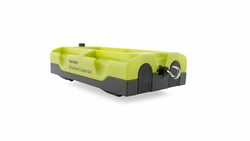
Vernier™ Go Direct™ Sensor Cart Yellow

Vernier™ Go Direct™ Sensor Cart Yellow features built-in, wireless sensors for one-dimensional dynamics and kinematics experiments.
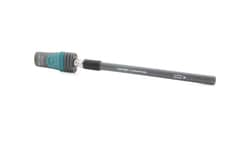
Vernier™ Go Direct™ Ammonium Ion-Selective Electrode
Vernier™ Go Direct™ Ammonium Ion-Selective Electrode can be used to measure the concentration of ammonium in aqueous samples.
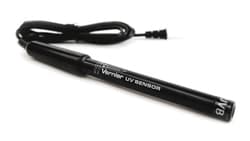
Vernier™ UVB Sensor
The UVB Sensor is an ultraviolet light sensor that responds primarily to UVB radiation (approximately 290 to 320 nm). It is ideal for experiments using sunlight as your UV source and is the sensor recommended for the UV experiments in our lab books.
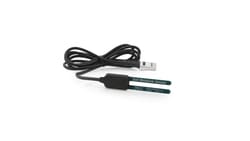
Vernier™ Soil Moisture Sensor
The Soil Moisture Sensor is used to measure the volumetric water content of soil. This makes it ideal for performing experiments in courses such as soil science, agricultural science, environmental science, horticulture, botany, and biology.
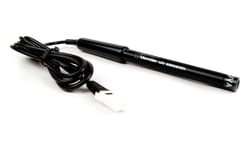
Vernier™ UVA Sensor
The UVA Sensor is an ultraviolet light sensor that responds primarily to UVA radiation (approximately 320 to 390 nm). This sensor is ideal for experiments using UV lamps.
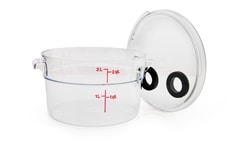
Vernier™ BioChamber 2000
The BioChamber 2000 is a 2000 mL plastic chamber that can be used with a Gas Sensor and an Gas Sensor to monitor gaseous carbon dioxide and oxygen levels simultaneously in a closed system. The BioChamber 2000 is particularly useful when monitoring respiration and photosynthesis. The large top opening provides easy access to insert, adjust, or remove the sample.
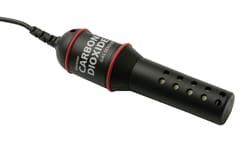
Vernier™ CO2 Gas Sensor
The CO2 Gas Sensor measures gaseous carbon dioxide in two ranges–0 to 10,000 ppm and 0 to 100,000 ppm.
Vernier™ Go!Motion to Computer Cable
This cable allows a Go!Motion or CBR 2 to connect to a computer. It is included with Go!Motion.
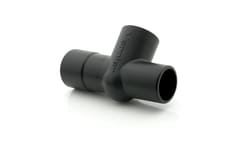
Vernier™ O2 Gas Sensor to Spirometer Adapter
This adapter facilitates the connection between an Oxygen Gas Sensor and a Spirometer when measuring the oxygen gas concentration and flow rate of exhaled air. It is used in .
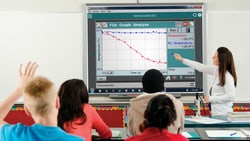
Vernier™ LabQuest Viewer (Download)
Allow you to display and control LabQuest on a computer to teach students how to use LabQuest, demonstrate experiments, or share class data.
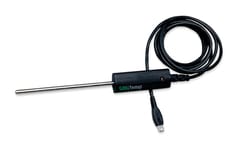
Vernier™ EasyTemp
The Vernier EasyTemp is a rugged, general-purpose temperature sensor for TI graphing handhelds.
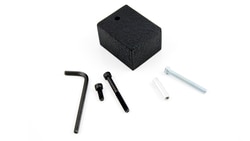
Vernier™ Mass for Dynamics Cart
This 500 g mass is used to add mass to a cart for dynamics experiments. It includes hardware for attaching to a Vernier Dynamics System cart or a PASCO dynamics cart, and leaves room for both a Dual-Range Force Sensor and an Accelerometer. Not compatible with newer plastic dynamics carts.

Vernier EKG Sensor
Measures electrical signals produced during muscle contractions.
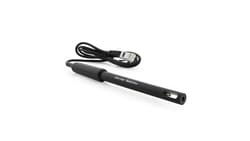
Vernier™ Salinity Sensor
The Salinity Sensor precisely measures the total dissolved salt content of ocean or brackish water.
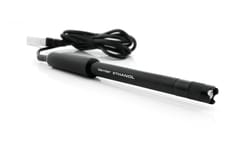
Vernier™ Ethanol Sensor
The Ethanol Sensor can be used to measure the concentration of ethanol in air above an aqueous sample.