Enzymes and Inhibitors


Terminal deoxynucleotidyl transferase (TdT), Murine, 2500 U, G-Biosciences

Terminal Transferase catalyzes the untemplated addition of deoxynucleotides to the 3' hydroxyl terminus of DNA molecules.
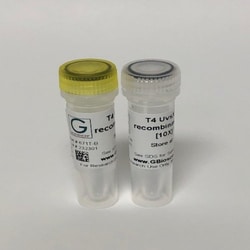
G-Biosciences T4 UvsX DNA Recombinase
T4 UvsX DNA recombinase mediates DNA strand exchange between homologous chromosomes.
End-Repair dA-tailing Mix, 24 reactions, G-Biosciences
The End-Repair dA-tailing Mix converts damaged or incompatible 5'/3′ ends to 3' A tailed and 5′-phosphorylated DNA.
T7 DNA Ligase, 75000 U, G-Biosciences
T7 DNA Ligase is an ATP-dependent enzyme from bacteriophage T7 that catalyzes phosphodiester bond formation between 5′ phosphate and 3′ hydroxyl termini of duplex DNA.
T7 Exonuclease, 2500 U, G-Biosciences
Gene 6 protein of bacteriophage T7 is a dsDNA 5' to 3' exonuclease which also exhibits flap endonuclease activity.
T4 RNA ligase I, 5000 U, G-Biosciences
T4 RNA Ligase I (gp63) catalyzes the ATP-dependent ligation of single-stranded nucleic acids by joining a 5′ phosphate to a 3′ hydroxyl. It is most efficient at ligating the 3′-OH of RNA to the 5′-phosphate of RNA or DNA in single-stranded contexts.
E. coli Pyrophosphatase (PPase), 50 U, G-Biosciences
E. coli Inorganic Pyrophosphatase (PPase) speeds up the breakdown of inorganic pyrophosphate (PPi) into orthophosphate.
E. coli Gyrase, 100 U, G-Biosciences
Gyrase is a type IA DNA topoisomerase and it is involved in bacterial DNA supercoiling.
T4 RNA ligase II, 750 U, G-Biosciences
T4 RNA Ligase II (gp24.1) repairs nicks in dsRNA and can also be used to ligate the 3' terminal OH of RNA to the 5'-terminal phosphate of DNA in a double-stranded structure.
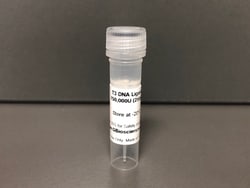
T3 DNA Ligase, 750000 U, G-Biosciences
T3 DNA Ligase catalyzes the formation of a phosphodiester bond between a 5' phosphate and a 3' hydroxyl termini in duplex DNA; joining blunt and cohesive end termini as well as repairing single stranded nicks in duplex DNA.
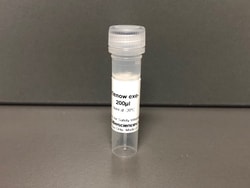
Klenow Exo, 1000 U, G-Biosciences
Klenow fragment (Exo-) is a mesophilic DNA polymerase deficient in both proofreading (3′→5′) and nick-translation (5′→3′) nuclease activities, with a moderate strand displacement activity during DNA synthesis.